Once Dedekind cuts are available, return to the familiar language of decimal expansions and ask a natural question:
How does a decimal such as determine a real number?
The answer is that a decimal expansion produces a nested family of rational approximations, and those approximations can be turned into a cut.
The structural boundary of the construction
The uniqueness theorem explains why the completed cut model represents the familiar real number system:
Theorem
There is one complete ordered field up to isomorphism
Any two complete ordered fields are isomorphic by an order-preserving field isomorphism. Thus a construction that satisfies the complete ordered-field axioms produces the real number system in the structural sense.
This theorem is a stated course boundary. The present notes use it to explain why different rigorous constructions describe the same real system, but do not prove the uniqueness theorem in this course.
Decimal expansions give lower and upper fences
Consider the decimal
Form the sequence of lower bounds
and the sequence of upper bounds
The idea is simple:
- the lower list truncates the decimal and stays below the target,
- the upper list moves one step above the truncation and stays above the target.
So the real number is trapped inside narrower and narrower rational intervals.
Worked example
Nested intervals for
Even without committing to a particular decimal such as , the same method can be seen clearly with :
Each extra digit shrinks the interval and gives a better rational fence.
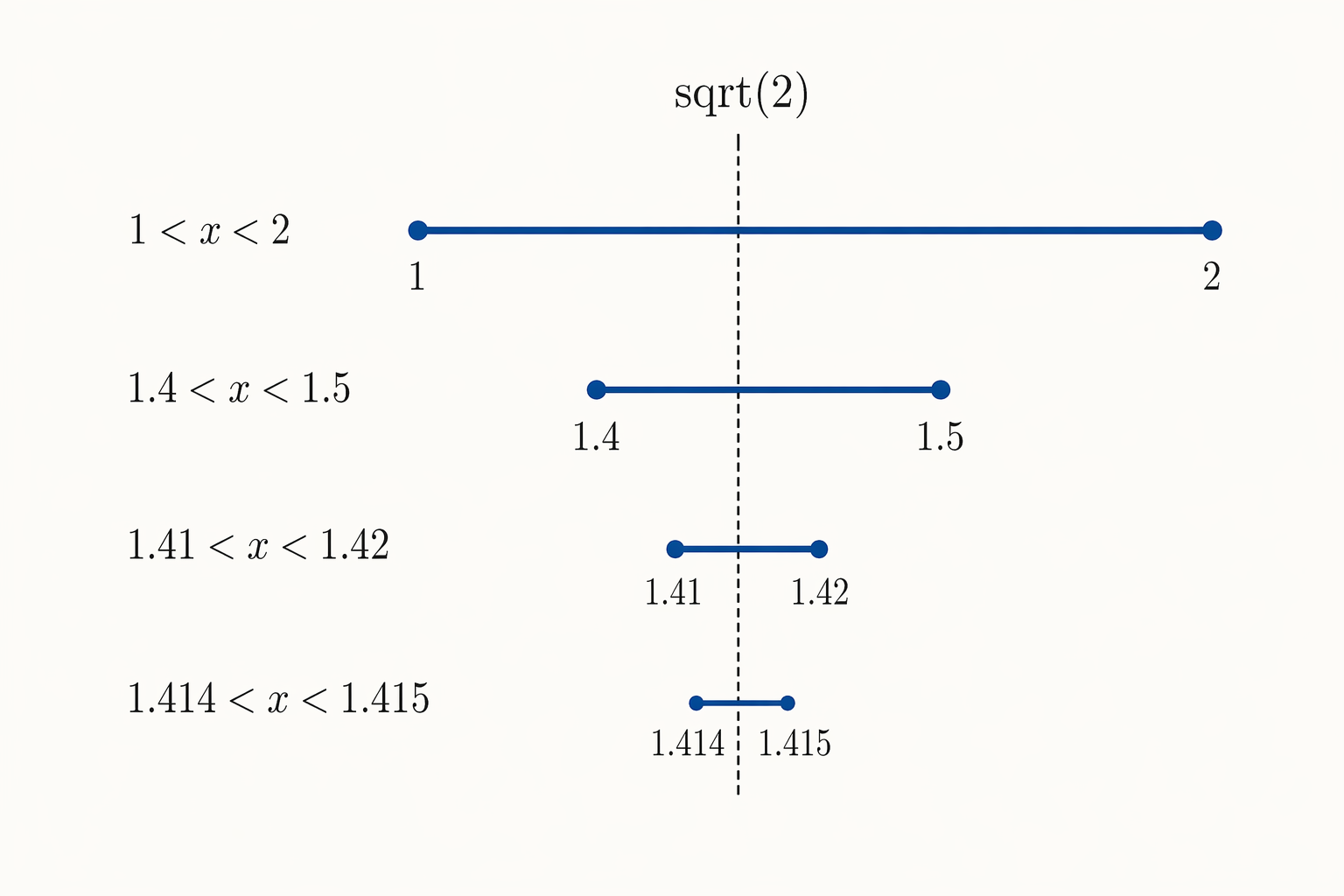
Figure. A decimal expansion does not merely list digits. It creates a chain of smaller and smaller rational intervals containing the target number.
Turning a decimal expansion into a cut
For an integer part and digits , put
The sum is empty at . Let and . Finite place-value arithmetic shows the lower fences are nondecreasing, the upper fences are nonincreasing, and for all finite . Define
Thus is the set of rational upper bounds of all lower fences. It is not the set of rationals strictly above some upper fence: that rule would lose a rational boundary such as from both sides.
The set is nonempty since ; it is proper since is above every truncation. If and , then , giving downward closure. Finally is a larger rational still below , so has no greatest element. Consequently is a cut, including for terminating decimals and tails of nines. The mesh can be made arbitrarily small: choose and use . This justifies the shrinking-fence interpretation without assuming an infinite string already denotes a real number.
Why decimal strings are useful but not the primary definition
The previous note already hinted at the main problem with taking decimal strings as the primary definition of real numbers:
- the same real number can have more than one decimal expansion,
- for example .
So decimal notation is excellent for intuition and approximation, but it needs a deeper structural interpretation. Dedekind cuts supply that interpretation.
Common mistake
A finite truncation is not the real number itself
The decimal is not . It is only a rational approximation from below. Likewise is not the exact number either; it is an upper fence. The real number is the boundary captured by the whole infinite approximation process.
Refining the rational interval
Use the builder below to reveal one more decimal digit at a time and watch the lower bound, upper bound, and interval width update together.
Read and try
Build decimal approximations as shrinking intervals
The builder turns a decimal expansion into successive lower and upper rational bounds, making the approximation process visible one digit at a time.
Using sqrt(2) makes the link to irrational numbers explicit: no finite decimal stage reaches the exact number, but the intervals keep shrinking around it.
Step
3
Lower bound
1.414
Upper bound
1.415
Step 0
1 ≤ x < 2
Interval width = 1
Step 1
1.4 ≤ x < 1.5
Interval width = 0.1
Step 2
1.41 ≤ x < 1.42
Interval width = 0.01
Step 3
1.414 ≤ x < 1.415
Interval width = 0.001
Irrational numbers inside
Once the real numbers are constructed, define:
Definition
Irrational number
An irrational number is an element of .
This definition is short, but its meaning is deep. An irrational number is not “mysterious” or “unfinished”. It is a perfectly legitimate real number that is simply not represented by any rational cut.
The real number
Set
The equality in the complement uses the earlier proof that no rational square is . The set is nonempty () and proper (). It is downward closed: below a nonpositive member everything is included; below a positive member, a positive rational has a smaller square. A nonpositive member is exceeded by , and a positive member is exceeded by the rational perturbation from 4.3. Thus has no greatest element and is a cut. It is strictly positive since it contains and also .
The cut really satisfies C times C equals 2_R
Use the nonnegative product definition from 4.5. A negative rational is in . For nonnegative , if , then ; the other order is symmetric. Hence .
For the reverse inclusion, negative rationals are already included. Given with , choose a rational . Apply the rational stepping argument from 4.5 starting at : there are and , with . Then , , and , so
Thus . Put ; then , so and belongs to . Therefore .
Worked example
Why this is an irrational cut
If , its boundary must have . If , then , contradicting . If , the downward perturbation from 4.3 gives a positive rational with , so but . Equality is impossible in . Hence is not a rational cut. We call the positive cut with the displayed square .
What decimals and irrationals are teaching you together
There are two compatible claims here.
- A real number can be approximated arbitrarily well by rationals.
- Some real numbers are nevertheless not rational.
Those statements do not conflict. In fact, they are exactly what makes the real number system powerful. Irrational numbers can be reached by rational approximations without ever turning into rational numbers themselves.
Decimal nonuniqueness and periodicity
Decimal notation is a representation, so it must be tested for uniqueness before it is used as a definition. The fundamental example is
For the truncations , , , and so on, the gap to is after digits. Given any , choose with . More precisely, bounds all truncations; for every , choose with , so . Hence is their supremum, and the cut is exactly . A decimal convention must therefore exclude tails of all s if a unique string representation is desired.
Theorem
Eventually periodic decimals are rational
If a decimal has a repeating block of length after initial digits, then it represents a rational number. Multiplying by and by shifts the repeating tail into the same position; subtracting cancels the infinite tail and leaves an integer equation with a nonzero integer coefficient. Solving that equation gives a quotient of integers.
Theorem
A terminating decimal has a periodic alternative
Every positive terminating decimal is rational and can also be written with a tail of s. For instance, . This follows by applying the same finite-place-value calculation behind ; it is another reason to treat decimal strings as names whose equality must be justified.
Worked example
Converting to a fraction
Let . Then , so subtraction gives , hence . The argument uses only finite subtraction after aligning the repeated block; it does not claim that every infinite decimal is periodic.
Worked example
Why a nonrepeating decimal can still be real
The decimal expansion of is not eventually periodic, but its finite truncations and one-step upper fences form nested rational intervals. Their widths tend to zero by the Archimedean estimate, and the associated cut gives one real boundary. Irrationality means that this boundary is not a rational element, not that it fails to be a real number.
The converse: rationals produce periodic decimals
The cancellation argument proves “eventually periodic implies rational.” The converse is also elementary. Write a rational number in lowest terms as , with . Long division repeatedly records a remainder in . If a remainder becomes zero, the decimal terminates. If not, some remainder repeats because there are only finitely many possibilities. The digits from the first occurrence of that remainder then repeat forever, so has an eventually periodic decimal expansion.
Theorem
Rationality and eventual periodicity
A real number represented in base ten is rational exactly when its decimal expansion is terminating or eventually periodic, after identifying the two representations such as and .
Reducing a general real number to its fractional part
For an arbitrary , the Archimedean property gives an integer with . Total order makes this integer part unique: if both and work, then neither can be strictly smaller than the other. Put , so . Construct the decimal digits of and then add back to every truncation. This reduces the general case to the unit interval while preserving the same error width.
Worked example
Constructing fractional digits by floors
For and , define . Then and the truncation satisfies . Therefore ; the digits construct nested rational fences for every real , with an explicit error bound independent of any picture of an infinite string.
The digit formula needs two checks. Put . Then , so . Taking floors gives ; subtracting proves that is one of the ten permitted digits. Next the weighted digit sum telescopes:
The last equality uses . Thus the digit construction really recovers the lower fences, rather than merely producing a list of allowed digits. For negative , the formula is an integer-plus-fraction decomposition: for example . It must not be read as concatenating the minus sign of with the digits of .
Worked example
A rational but nonterminating expansion
The fraction has no terminating decimal because a terminating decimal has denominator, after reduction, containing only factors and . Long division gives ; the repeated remainder explains the period.
Common mistake
Nonterminating does not mean irrational
is rational because the digits are eventually periodic. Irrationality requires failure of eventual periodicity (or an independent proof that the real is not in ), not merely infinitely many digits.
Quick checks
Checkpoint
For the terminating decimal , which side of the cut contains : or ? Explain from the definitions.
Use all lower fences, including the ones that equal the boundary.
Solution · Answer
Every lower fence is at most , so belongs to , the set of rational upper bounds of all lower fences. It does not belong to : no lower fence is strictly greater than . This is why defining as the complement of handles a rational boundary correctly.
Exercises
Checkpoint
Write the first four lower and upper rational fences suggested by the decimal .
Begin with the integer interval and then reveal one more digit at each step.
Solution · Guided solution
One possible chain is
Each step traps the target in a narrower rational interval.
Checkpoint
Starting from the informal decimal , write four lower fences, four upper fences, and the corresponding cut .
Follow the same construction used above.
Solution · Guided solution
One valid choice is
Then
The exact later digits do not affect the argument: lower fences increase, upper fences decrease, and the two families enclose one boundary.
Checkpoint
Why does the cut represent an irrational number?
Use what was already proved about rational squares.
Solution · Guided solution
If the cut were rational, then its boundary would be some rational number with . But earlier results show that no rational has square . Therefore the cut cannot be rational, so the corresponding real number is irrational.
Checkpoint
If the first decimal digits of a cut are already known, how should the next digit be selected?
Describe the rule in terms of the embedded rational cuts.
Solution · Guided solution
Test the ten candidates in the next place. Append each candidate to the current truncation and choose the largest candidate whose embedded cut satisfies . That candidate is the next lower fence; the matching upper fence is one place-unit larger.
Related notes
Read this after 4.5 Dedekind cuts and the embedding of Q and 3.5 Gaps in Q and why sqrt(2) is not rational. Then continue to 5.1 Sequences and epsilon-N limits.