Chapter 5 now shifts from sequences to functions. The new difficulty is that a sequence approaches its limit through the discrete parameter , while a function argument can move toward a point through infinitely many nearby real values from both sides.
This is why the - definition is needed.
From sequence limits to function limits
For sequences, the definition of
said that every small tolerance around can be achieved by going far enough out in the sequence.
For functions, we want an analogous sentence:
as approaches , the function value approaches .
But now “going far enough out” no longer makes sense. We need a new way to say that is close enough to . That role is played by .
Open intervals and punctured domains
First specify the kind of domains involved.
Definition
Open interval
An open interval is a subset of of one of the forms
where and .
To define a limit at a point , consider functions defined on an open interval with the point removed. That removal is important: a limit is about what happens near , not necessarily what happens at .
The formal delta-epsilon definition
Definition
Limit of a function at a point
Suppose is an open interval containing , and let . We say
if and only if for every , there exists such that
The implication is required for every . The number may depend on , but not on the input .
Read the implication carefully:
- means is close to , but not equal to ;
- means the function value lands inside the -band around .
So the definition says:
Every requested output accuracy can be guaranteed by forcing the input into a sufficiently small punctured neighborhood of .
Common mistake
The limit definition ignores the value at a
The condition removes the point itself. So may be undefined, or may differ from , while the limit still exists.
First example:
The basic linear test case is the function at .
Worked example
Choosing
Let , , and . Then
So in order to force , it is enough to make
Therefore choose
Then whenever ,
Hence
This example shows the standard proof pattern:
- start with ,
- simplify it into an expression involving ,
- choose to make that expression smaller than .
Two more basic examples
Worked example
Constant functions
If for all , then
for every and every .
So any positive number can be chosen as , and
Worked example
A function with a hole
Consider
The formula is undefined at , but for it simplifies to
So near ,
Therefore choosing works. If , then
Hence
even though is not defined.
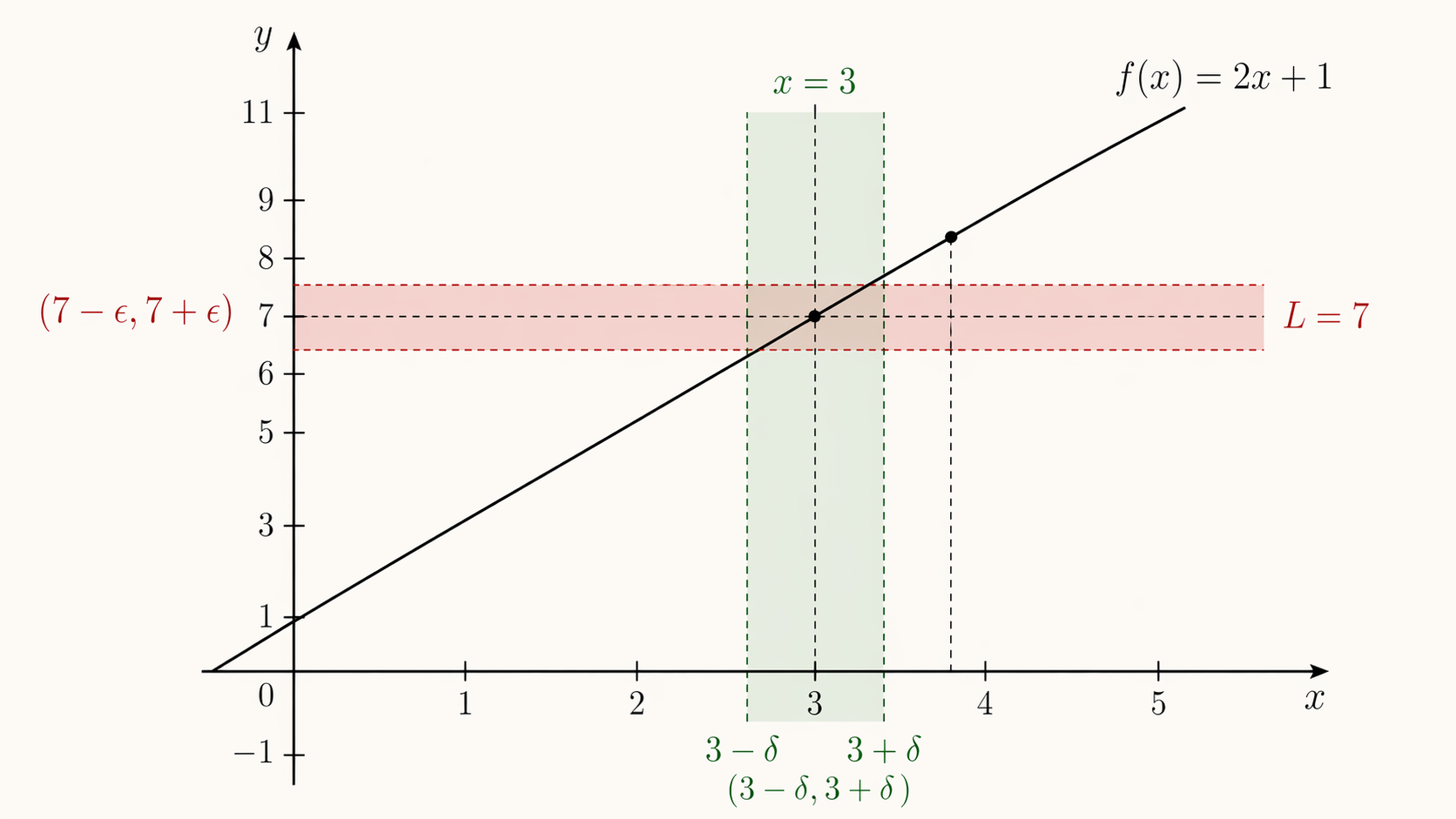
Figure. The - definition links an input neighborhood of to an output band around . The proof task is to choose so that this implication always succeeds.
Explore the definition interactively
The explorer below lets you choose one of the examples, select , and test sample inputs . The point is to see the implication
as a relationship between an input strip and an output band.
Read and try
Check one delta-epsilon implication geometrically
The condition 0<|x-a|<delta must imply |f(x)-L|<epsilon for every permitted x. A sample illustrates this implication; an algebraic error bound proves it for the whole punctured interval.
0 < |x - a| < δ, with δ = 0.25
3
x = 2.8
|f(x) - L| < ε, with ε = 0.5
7
f(x) = 6.6
0 < |x - a| < δ
|2.8 - 3| = 0.2
The chosen x really lies inside the delta-neighbourhood.
|f(x) - L| < ε
|6.6 - 7| = 0.4
The function value lands inside the epsilon-band around L.
How limits can fail to exist
Next, consider how to show that a proposed limit does not exist.
To prove , one must find a single such that no matter how small is chosen, some point with still satisfies
Consider
which equals for and for .
Worked example
Why has no limit at
Take . For any , choose
Then both satisfy , but
No single real number can lie within distance of both and . Therefore the function has no limit at .
For a nonexistence proof, the quantifiers reverse the practical strategy. To show that cannot have limit , it is enough to find one fixed such that every admits a punctured point with . For at zero, any proposed fails: the positive and negative sides give values and . If , take a negative-side point and obtain ; if , take a positive-side point and obtain . Both points can be chosen inside every prescribed punctured neighborhood. This is a direct epsilon contradiction, rather than the informal statement that the graph “jumps.”
This example captures a common failure mode: left-hand and right-hand behavior do not agree.
Algebra of limits
Once some basic limits are known, limit laws show how to build new ones from old ones.
Theorem
Limit laws
If and , then:
- ,
- ,
- if , then
One neighborhood for the sum law
The sum law illustrates the quantifier pattern in its shortest complete form. Suppose and , and fix . The first limit supplies such that whenever ; the second supplies with the analogous bound for . Set . The same then satisfies both estimates, and therefore
The minimum is essential: it creates one neighborhood on which every required estimate holds simultaneously. A proof that chooses two unrelated input points, or that lets depend on , has not established the quantified implication.
Proofs of the product and quotient laws
The product law is more than a symbolic rule: its proof must control two errors at once. Assume and have limits and at , and let be given. No value is needed: every estimate below concerns the punctured domain. First use the limit of with tolerance to choose such that every with satisfies
Here is a local bound, obtained before the final epsilon budget. Choose so that every with gives . Choose so that every such with gives , where . Set . For any with , all three estimates hold; the identity
and the triangle inequality give
This proves , including the case ; the use of avoids dividing by zero in that case.
For the quotient, the assumption is essential. Since has limit at , choose so that every with satisfies . Then
On this same neighborhood, the reciprocal error satisfies
Given , additionally choose so that every with satisfies ; intersecting the two neighborhoods proves . Applying the product law to and now gives
Every budget and every denominator condition is visible: first local boundedness, then the two half-errors, and then the lower bound that makes reciprocation legal.
Worked example
Using the sum law
Consider and near . Once the basic limits
are known, the sum law gives
Worked example
Two divergent limits whose sum converges
A sum can have a limit even when neither summand does. On the punctured real line near , define
Neither function has a limit at : for , the two sequences and give output limits and for , and the corresponding outputs and for . Nevertheless, for every allowed , so the sum has limit . This is why a limit-law hypothesis cannot be inferred from the existence of the combined expression.
Worked example
The continuous limit at zero
For , the candidate limit at zero is . Restrict to , which guarantees . Hence
Given , choose
Then implies the denominator is nonzero and the displayed error is less than . Therefore
The sequential characterization
The sequential criterion connects function limits back to sequence limits.
Theorem
Sequential characterization of function limits
Let . Then
if and only if for every sequence with for all and , we have
This theorem is extremely useful because it gives two complementary methods:
- to prove a limit exists, check every sequence approaching ;
- to prove a limit does not exist, find two sequences approaching that give incompatible output behavior.
Apply this criterion to the oscillating function near .
Worked example
Two sequences proving that has no limit at
Take the indices . Then
Then and , but
while
Since two sequences approaching the same point produce different limiting function values, does not exist.
Proof of the sequential characterization
The theorem has two directions, and each uses a different quantifier order.
Function limit implies every sequence limit
Assume the punctured function limit is . Let be any sequence in with . Given , choose from the delta-epsilon definition, so implies . Since , choose so that every has . The sequence stays in the punctured domain, so and therefore for every . This is exactly .
Every sequence limit implies the function limit
For the converse, argue by contrapositive. Suppose the function limit is not . Then there is a fixed such that for every one can find a point in the punctured domain with . For each , apply this failure with and choose satisfying
The middle inequality proves , but the last inequality prevents , since the same positive error survives at every index. This contradicts the assumed sequential property. Thus the function limit must be . The choice explicitly avoids , even when is undefined.
Continuity
One of the main purposes of limits is to make the idea of continuity precise.
Definition
Continuity at a point
Let and . The function is continuous at if
Equivalently, in - language:
Notice what changed: the condition disappeared. Continuity really does care about the function value at the point.
A standard discontinuous example is:
Here the nearby values are all , so the limit near is not . Therefore the function is discontinuous at .
Common mistake
A function can have a limit at a without being defined at a
The hole example shows this clearly. Limits are about nearby values. Continuity adds the extra requirement that the function is defined at the point and that its value agrees with the limit.
Quick checks
Checkpoint
Why does the function-limit definition use instead of only ?
Think about whether the value at should matter for the limit.
Solution · Answer
Because the limit concerns points near , not necessarily the point itself. The strict inequality removes from the condition.
Checkpoint
Why does the sum-law proof use instead of ?
State what must be true of the same input point for both estimates to apply.
Solution · Answer
The input must satisfy both and . Taking the minimum guarantees both. Taking the maximum can admit points outside the smaller neighborhood, where one of the two error estimates is no longer guaranteed.
Checkpoint
Why must a reciprocal-limit proof first show that the denominator stays away from zero?
Identify the quantity that could magnify an otherwise small numerator error.
Solution · Answer
The reciprocal error is . Even a small numerator gives no control if can be arbitrarily close to zero. When , the preliminary bound replaces the denominator by a fixed positive lower bound and makes the subsequent error estimate valid.
Exercises
Checkpoint
Prove that .
Rationalize and also keep x near 4 so the denominator stays away from zero.
Solution · Guided solution
We use
Choose
If , then in particular , so . Hence
Therefore .
Checkpoint
Two sequences approach zero and both give output zero for . Does that prove the function limit is zero? Use and , , and justify your answer.
Compare the universal quantifier in the sequential criterion with what two examples establish.
Solution · Model solution
Both displayed sequences tend to zero and both output sequences are constantly zero. This is insufficient because the criterion requires every sequence in the punctured domain. The additional sequence also tends to zero, but for every . Thus the candidate limit zero fails, and the conflicting output limits show that no function limit exists.
Checkpoint
What extra condition must be added to ‘the limit of f(x) as x approaches a exists’ in order to conclude that f is continuous at a?
Compare the definitions of limit and continuity.
Solution · Guided solution
You must also have defined and equal to the limit:
That equality is exactly the definition of continuity at .
Prerequisites and continuation
Read this after 5.1 Sequences and epsilon-N limits and 5.2 Cauchy sequences and another model of the reals. For the order-theoretic background behind completeness, see 4.3 Completeness and gaps in Q.