Why cuts are the next step
The previous note ended with a picture:
- a real number should determine everything in that lies to its left;
- it should also determine everything in that lies to its right;
- the real number itself should behave like the boundary between those two camps.
The next step is to turn that picture into a formal definition. The important move is this: instead of assuming the real number already exists and then asking what lies below it, we define the real number by the left-hand part of itself.
That is the basic idea of a Dedekind cut. The construction has four tasks: identify the boundary data, recover the rational numbers inside it, define compatible order and arithmetic, and prove that every nonempty bounded family has a least upper bound. The last task is what fills the gaps in .
Two equivalent definitions
Definition
Dedekind cut as a pair
A Dedekind cut is a pair of nonempty subsets of such that:
- ;
- for every and , we have ;
- has no maximum element.
In words, is the entire left side of the boundary, and is the entire right side. There is no overlap, nothing is missing, and the left side does not contain its own last point.
Definition
Dedekind cut as a single subset
Equivalently, a subset is called a Dedekind cut if:
- and ;
- whenever and satisfy , then ;
- for every , there exists with .
The second form is often easier to use. Once the left set is known, the right set is automatically . So the cut is completely determined by which rationals count as "already to the left of the boundary".
Why the two definitions agree
For a pair , the strict separation forces disjointness, so . If and , then cannot belong to , because separation would require ; hence . Nonemptiness, properness, and no greatest member follow from the pair axioms. Conversely, start with a lower cut and put . Both sides are nonempty. If , , then is impossible: equality contradicts membership, and contradicts downward closure. Thus , and all pair axioms hold.
What each condition is doing
The definition is short, but every clause has a job.
- and prevent a fake cut with no left side or no right side.
- Downward closure says that if a rational is already on the left, then every smaller rational must also be on the left.
- The "no maximum" condition says the boundary itself is not stored as the last element of ; there is always room to move a little farther right while staying on the left.
This last point is the subtle one. It is exactly what prevents one rational number from being represented twice.
Worked example
The cut for
Let
Then and are both nonempty, every element of is smaller than every element of , and has no maximum.
To see the last point, start with any and define
Then , so and was not maximal. Thus is a Dedekind cut. This cut is the rational number viewed inside the real number system built from cuts.
Rational cuts and the embedding of
Call a cut rational if has a minimum element. In that case the boundary is already achieved by a rational number.
If , then necessarily
That motivates the notation
So each rational number gives a Dedekind cut , and the map
embeds into the cut model of the reals.
Theorem
The rational numbers sit inside the cut model
Rational Dedekind cuts are in bijection with rational numbers. After this embedding is established, it is standard to identify with its cut . In particular, and play the roles of and inside .
This matters conceptually. The cut construction is not trying to throw away the rationals and start from scratch. It is enlarging by adding new boundaries that were missing before.
Common mistake
Using instead of
The set is nonempty, proper, and downward closed, but it fails the "no maximum" condition because itself is the largest element. If we allowed that set as well as , then the same rational number would be represented in two different ways. The strict inequality is not cosmetic; it removes that ambiguity.
Order and the first operations on cuts
Defining the set of all cuts is not enough. To match the target from the previous note, we must also define order and arithmetic on .
For order, the natural rule is:
This is exactly the right comparison for left sets. If every rational already on the left of is also on the left of , then the boundary represented by cannot lie to the right of the boundary represented by .
Theorem
Cut inclusion is a total order and preserves rational order
Inclusion is reflexive, antisymmetric, and transitive. If cuts satisfy , choose . Every has : otherwise downward closure of would force . Thus , so cuts are totally comparable.
For rationals ,
The forward implication follows from transitivity. For the converse, if , the midpoint belongs to but not to , contradicting the inclusion. In particular, equal rational cuts have equal rational boundaries, so the embedding is injective.
For addition, define
The idea is that the left side of a sum should consist of rational numbers that can already be reached by adding something strictly left of the first boundary to something strictly left of the second boundary.
Addition produces a cut and has the expected laws
Choose , to witness nonemptiness. Choose , ; every sum is strictly below , so the sum is proper. If and , then lies in , hence lies in the sum. To improve , choose with ; then lies in the sum. These verify all four lower-cut conditions.
Associativity follows because both and consist exactly of the rational sums ; commutativity follows likewise. Moreover : adding a negative rational moves downward inside ; conversely, for choose with , and write .
Worked example
Why
Write
If and , then , so every element of lies in .
Conversely, if , then , and
So every rational in lies in . Hence
This example shows that the cut definition really extends the ordinary rational operations rather than inventing new arithmetic.
Additive inverses require a strict gap
Define
The strict inequality matters. Simply reflecting the complement would put into the proposed inverse of , creating a greatest element.
Existence and uniqueness of the additive inverse
The displayed set is nonempty: if , then belongs to it. It is proper: for , every such satisfies , so is excluded. Downward closure is immediate, and the midpoint of and its witness gives a larger member. Thus is a cut.
We need a rational gap lemma. For any rational , choose and . The Archimedean property of gives a positive integer with . Among the positive integers for which , take the least. Then and .
If and with witness , then and , proving . Conversely, for any rational , apply the lemma with . It gives and ; then , so and . Therefore .
If another cut satisfies , associativity and the zero identity give . This proves uniqueness. For , the definition gives , with witness for every . If is irrational, its complement has no least member; therefore the strict gap definition also equals in that case.
Multiplication on nonnegative cuts
Addition and additive inverses are now established. For multiplication, first define the product for nonnegative cuts, where multiplying rational members respects the direction of the boundaries; sign rules will then handle the other cases. For , define by
The negative rationals are included deliberately. They provide the whole negative part of the new lower set, while the products of nonnegative members locate its nonnegative part.
If or , the corresponding nonnegative member set is empty, so . Suppose now that . Each cut contains a positive rational: if a nonnegative member is available, use the no-greatest-member property; if not, the cut would be . Choose positive and . This proves nonemptiness of .
Choose positive rationals and . Every nonnegative satisfies and , hence . Thus is not in , proving properness. Downward closure is immediate for negative . If with nonnegative, then and with ; downward closure of puts in , so .
Finally, a negative member can be increased slightly while staying negative. A zero member can be increased to a positive product because both cuts are positive. If , choose in ; then , and is still in . These cases prove that has no greatest member. Therefore the nonnegative product is itself a Dedekind cut.
Product laws and the rational restriction
Commutativity follows by interchanging the two rational factors. For the identity, let . If , then for every nonnegative , so downward closure gives . Conversely, if , choose with ; then and with , proving . Negative rationals are present on both sides. The zero case is already covered by .
For positive rationals , every nonnegative product of members of and is below , so . Conversely, if , choose rational with
and put . Then , so , , and . The zero cases and sign rules give for all rational signs.
For positive cuts , a nonnegative member of has the form , where are nonnegative members of the three cuts. The same description, regrouped as , gives a member of , and the reverse inclusion is identical. Negative rationals occur in both products. If one cut is zero, both bracketings are zero. This proves associativity directly from rational associativity and the cut definitions; no real-number associativity has been assumed.
Distributivity: the shared-factor argument
We first record a representation fact. If and lies in , then for nonnegative . Indeed, start with any representation . If one summand is negative, replace it by and replace the other by ; the replacement is smaller than the old positive summand and therefore remains in its cut. This lemma is intentionally restricted to strictly positive cuts: contains no nonnegative rational, so it would be false in a zero case, for example with .
For positive cuts , take a nonnegative . Write with nonnegative . The representation fact puts in . Conversely, apply the representation fact to the sum and write its nonnegative member as , with nonnegative . By the product definition, write and with nonnegative factors in the corresponding cuts. Choose strictly above and ; it is positive. Then
Both coefficients lie in , so the bracket belongs to and hence . Negative rationals occur on both sides. If , then ; the cases or are the same direct calculation using the zero product and addition laws. This proves distributivity for nonnegative cuts without limits or an unconstructed real root.
Signs and order compatibility
Extend the product by
For the other mixed-sign order, if , set . Use the zero product when either factor is . A product of two nonzero positive cuts is positive, so these rules give the expected sign of every product. Associativity for arbitrary signs reduces to the already proved positive-magnitude associativity together with additive inversion.
The mixed-sign distributive step is also explicit. For nonnegative with , the cut difference is nonnegative and . Nonnegative distributivity gives
If , interchange them and negate the resulting equality. This identity handles a mixed-sign second or third summand; a negative first factor is then handled by the sign rule and additive inversion. Thus distributivity holds for all signs.
The order is compatible with translation because implies ; the converse follows by adding to both sides. Products of nonnegative cuts are nonnegative by definition. If and , then , so ; distributivity gives , hence . This proves the ordered-field compatibility of the cut operations.
General multiplicative inverses
Let . Choose a fixed positive rational . Every rational then satisfies . Define
This definition works for rational and irrational cuts alike. It is nonempty, and contains a positive element such as for any chosen outside . Every member is below , so is proper; downward closure is immediate, and the midpoint between and its witness gives a larger member. Thus is a cut.
If are nonnegative and witnesses membership in , then , so . Hence . For the reverse inclusion, let be rational and choose rational
The rational stepping lemma gives and , with . Then . Put . We have , so and . Negative rationals are automatic, therefore .
For , define ; zero is excluded because no product with can equal . For positive rational , the same definition reduces to , and signs give the negative rational case. If , then associativity and the identity yield
so the inverse is unique.
Completeness in the cut model
The cut construction makes the least-upper-bound property visible. Let be a nonempty family of cuts bounded above by a cut . Define
The set is nonempty because is nonempty. It is proper because every lies below , so , and . Downward closure passes to a union: if , then for some , and every rational below is in and hence in . If , choose with using the no-greatest-element axiom for ; then . Therefore is a cut. It is an upper bound of , and any other upper bound contains each , hence contains their union. Thus is the supremum of .
Theorem
The union construction supplies a supremum
For nonempty bounded families of Dedekind cuts, the union of the left sets is the least upper bound. The proof uses exactly nonemptiness, properness, downward closure, and no greatest element; none can be silently dropped.
General nonnegative square roots
Now that the ordered-field laws and union completeness have been established, we can use the supremum property inside the complete ordered field . Let and define
The set is nonempty because . It is bounded above by : if is larger than both and , then , using positivity and multiplication of positive elements. Let , so .
The perturbations below are elements of the complete field ; no rationality of this is being claimed. The earlier rational gap lemma used for cut construction is a separate statement with rational .
Suppose first that . Choose
Then , so , contradicting that is an upper bound. Suppose instead that . Then . Choose
The estimate holds. Every satisfies , because would imply . Thus is also an upper bound for , contradicting the leastness of . Therefore .
If , then , so two nonnegative square roots cannot differ. We have proved existence and uniqueness of the nonnegative square root of every nonnegative cut, including the boundary case , whose root is .
The multiplicative Archimedean corollary
For positive cuts , the additive Archimedean argument applied to gives an integer with . Multiplying this strict inequality by the positive cut preserves its direction, and therefore
This corollary uses the inverse and order-compatibility laws already proved. The earlier rational gap lemma depended only on the arithmetic of .
Worked classifications of cuts
A formula defining a subset of must pass all the cut axioms. Odd powers give a useful family of examples; even powers and arbitrary set operations show why each axiom needs its own check.
Odd powers give lower cuts
For an odd positive integer and positive rational , the set
is a cut. Odd powers are strictly increasing on : for nonnegative , factor ; for negative , apply the same positive argument to and use that is odd; if , then . If , choose a rational with
The factorisation of has terms, each bounded in absolute value by , so ; this proves there is no greatest member. Downward closure follows from monotonicity: if , then . An integer supplies nonemptiness and properness.
Worked example
Polynomial conditions: locate the failed axiom
Both and are cuts by the odd-power argument. In contrast, is not a cut: belongs but does not, so downward closure fails. The set fails properness.
The set is a cut despite its weak inequality. No rational fifth power is : in a lowest terms fraction , the equation makes both and even. The weak inequality therefore defines the same cut as .
Worked example
Set operations that preserve or destroy cuts
Let and be cuts. The arbitrary product set is not necessarily a cut: for it is , which contains but not , violating downward closure. The difference set is always all of : given , choose and a rational ; then , , and . It is therefore not proper. The set is not necessarily a cut: for it is , whose greatest element is . For an irrational cut it agrees with the strict-gap inverse; the zero cut shows why the formula does not work uniformly for all cuts. The intersection is always a cut because total comparability makes it the smaller of the two cuts; the no-greatest witness is the smaller of two members chosen above a given element.
Worked example
The zero cut and its additive inverse
The embedded zero is . The cut representing its additive inverse is itself, because adding two negative rational left parts produces a left part below zero and every rational below zero can be split as . This illustrates why the inverse is an equality of cuts, not merely an informal reflection of a picture.
Worked example
Adding embedded rationals
For and , the cut addition is . Every such sum is below ; conversely, if , put and , so . Hence the sum equals , so the embedding respects addition.
Seeing the boundary on the number line
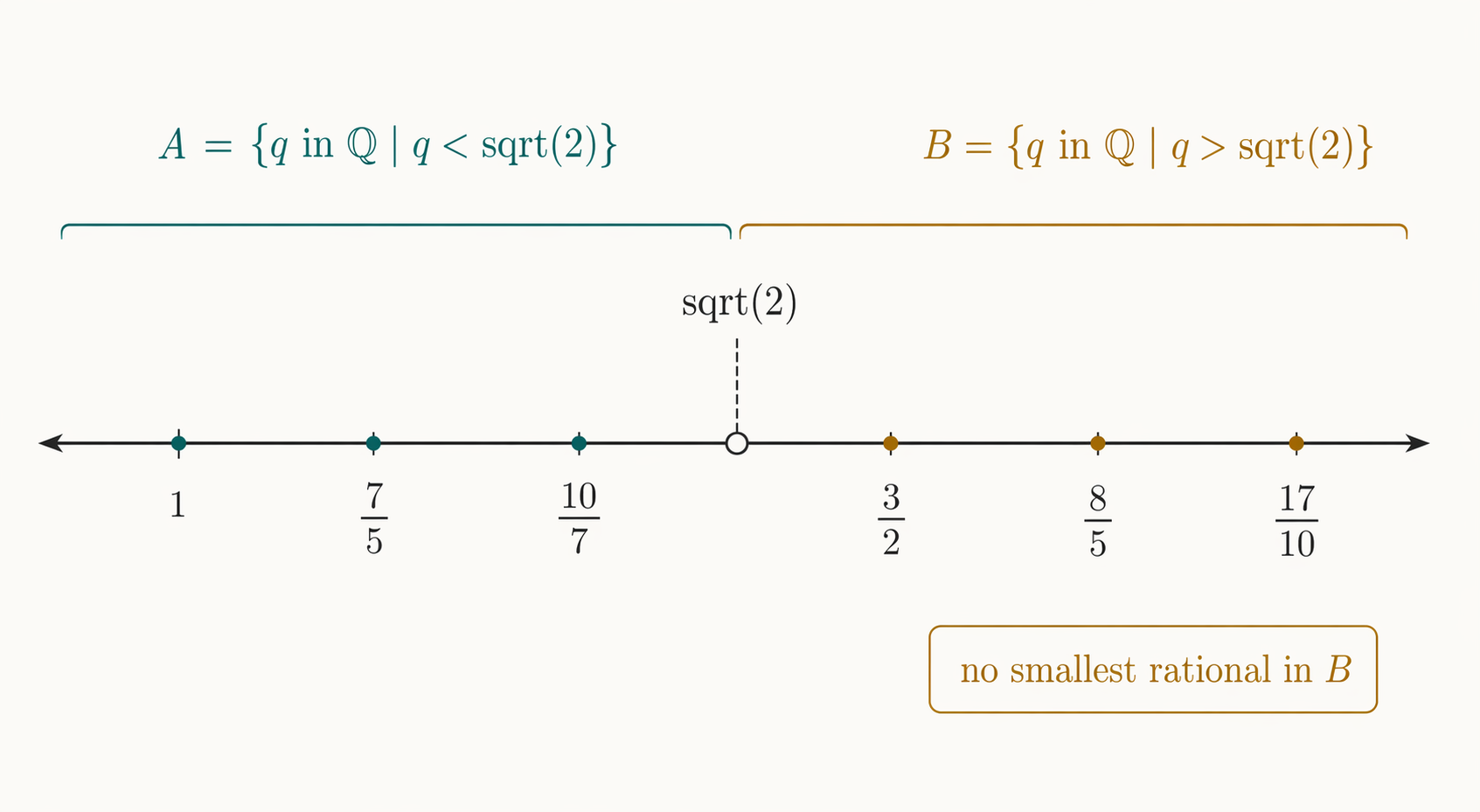
Figure. A cut stores every rational to the left of a boundary. When the boundary is , the right side has no smallest rational element.
Compare rational and irrational boundaries
The explorer below places the rational boundary next to the irrational boundary . The key structural question is whether the right-hand side starts with a least rational element.
Read and try
Inspect the two sides of a Dedekind cut
The worked cut places sample rationals on the two sides and exposes the structural difference between rational and irrational cuts.
What to notice
No rational equals sqrt(2), so the rationals to the right never start with a smallest one. This is the signature of an irrational cut.
A = { q ∈ Q | q < sqrt(2) }
B = { q ∈ Q | q > sqrt(2) }
1
A
6/5
A
7/5
A
10/7
B
3/2
B
8/5
B
17/10
B
sqrt(2)
Set A
1, 6/5, 7/5
Every displayed element is strictly left of sqrt(2), and more rationals can always be inserted still closer to the boundary.
Set B
10/7, 3/2, 8/5, 17/10
No rational equals sqrt(2), so the rationals to the right never start with a smallest one. This is the signature of an irrational cut.
Common mistakes
Common mistake
The pair version and the subset version are not two different theories
They describe the same object from two angles. The pair records both sides of the boundary explicitly, while the subset form keeps only the left side and recovers the right side as .
Common mistake
Order on cuts is not a comparison between every element of two sets
The statement means . It does not mean that every element of is less than every element of . The two left sets usually overlap heavily, especially when one boundary lies to the left of the other.
Quick checks
Checkpoint
What is the cut ?
Write it directly from the definition .
Solution · Answer
so it is the set of all negative rational numbers.
Checkpoint
If , which boundary lies to the left?
Answer in terms of the cut order.
Solution · Answer
If , then . The boundary represented by lies at or to the left of the boundary represented by .
Exercises
Checkpoint
Show that is a Dedekind cut for every rational number .
Check the three conditions in the subset definition.
Solution · Guided solution
The set is nonempty because , so . It is not all of because .
It is downward closed: if and , then certainly , so .
It has no maximum: if , then
is rational and satisfies , so . Therefore every element of can be improved by a larger element still in .
Checkpoint
Does the intersection of every nonempty family of Dedekind cuts have to be a cut? Test the family , where .
Compare finite intersections with the intersection of this decreasing family.
Solution · Model solution
Every nonpositive rational belongs to every . If , choose an integer ; then , so . Hence
This set has greatest element and is not a cut. Finite intersections are cuts because a finite family has a smallest member under inclusion. That argument cannot be extended to an arbitrary family without checking that such a smallest member exists.
Related notes
Read this after 4.4 Axioms for the reals and first approximations. Then continue with 4.6 Decimal expansions and irrational numbers, which reconnects cuts with familiar decimal notation and introduces as an irrational cut.